How Soon Should You Begin Studying for the CFP Exam?

Before you map out your CFP® exam study plan, find out how much time it really takes to be ready.
If you’re preparing for the CFP® exam, one of your first questions is probably how much time you’ll need.
Think of it like training for a marathon. Nobody gets race-ready in the final week, and nobody walks into the CFP® exam ready after a weekend of cramming. Readiness takes practice. Below, you’ll learn how to work backward from your exam date, what your study time should include, and why an early start gives you an edge.
How many hours should you study for the CFP® exam?
Here’s the short answer: most candidates need about 225–250 hours to be truly exam ready. Your number may be higher or lower. Those newer to financial planning or coming back after a tough first attempt may want to build in extra time.
If you’re taking a reputable CFP® exam prep program like The Dalton Review® Guarantee to Pass™, your total study time should include live review classes. The rest is self-study that you’ll do before, between, and after your classes.
To get in the recommended 225–250 hours, most candidates should start studying at least three months before exam day. The Dalton Review® is designed to prepare you in 2–3 months, depending on the study calendar and class schedule you choose. But how many hours you can study each week will make a big difference.
How to figure out when to start studying
The best rule of thumb is simple. Know how many hours you need, know how many hours you can give each week, and count backward from exam day. Here’s how:
- Choose your exam window. CFP Board offers the exam three times a year, in March, July, and November. Check CFP Board’s website for current dates and registration deadlines.
- Be honest about your weekly study time. Look at work, family, and travel. Ten steady hours a week beats 20 hours one week and two the next.
- Divide 225–250 by your weekly hours. That’s how many weeks you’ll need.
- Count backward from your exam date and add a buffer. Life happens. A week or two of cushion keeps one busy stretch from derailing your plan.
- Line it up with your review class schedule. Plan to do self-study work before your live classes. Classes typically wrap up about three to four weeks before the exam, which leaves time for your final practice.
How many weeks do you need?
Here’s how weekly study hours translate into a start date, based on 225–250 total hours:
| Study hours per weekWeeks neededStart studying about… | ||
| 5 | 45–50 | 11–12 months before the exam |
| 10 | 23–25 | 6 months before the exam |
| 15 | 15–17 | 4 months before the exam |
| 20 | 11–13 | 3 months before the exam |
For example, if you can study 10 hours a week, you’ll need about 23–25 weeks, or roughly six months. On the other hand, if you can commit about 20 hours a week, three months is realistic.
Why starting early pays off
Starting early isn’t about studying more. It’s about studying smarter, with time on your side. An early start gives you room to:
- Space out your study sessions, which research shows builds stronger long-term recall than cramming
- Find your weak areas early, while there’s still time to fix them
- Absorb a busy week at work or at home without falling behind
- Get more reps on exam-style questions before test day
Musicians rehearse a piece hundreds of times before they perform it. Pilots log hours in a simulator before they fly. The CFP® exam works the same way: it rewards the prepared, not the lucky. The more reps you get before exam day, the more confident you’ll be when it counts.
What your study time looks like with The Dalton Review®
For more than 20 years, The Dalton Review® has helped candidates prepare for the CFP® exam, and about half of today’s CFP® professionals trained with Dalton.
The program was redesigned with a new learning platform that includes AI-powered study tools, built-in targeted practice, and progress tracking by topic to make every study hour count even more. It blends self-study with live, instructor-led classes and follows a four-stage study path. Whichever class schedule you choose, you’ll have the same self-study resources and cover the same material in class.
Stage 1: Assess where you stand
When you log in, your schedule and study plan are waiting for you. In your first week, take the Review Readiness Quiz. It gives you a starting benchmark and shows which topics need the most attention. Guided onboarding then walks you through how to complete the program, and clear course navigation takes you through each step in order.
Stage 2: Learn, practice, and apply
Each week focuses on the chapters in your schedule. You’ll work through them online, quiz yourself, and apply what you learned in a case study. Every chapter includes:
- A downloadable Quick Reference Guide with the chapter’s key facts, formulas, and rules
- Micro Learning Units on high-priority exam topics with case study walkthroughs
- Key Rules and Check Your Understanding questions to confirm you’ve got it before moving on
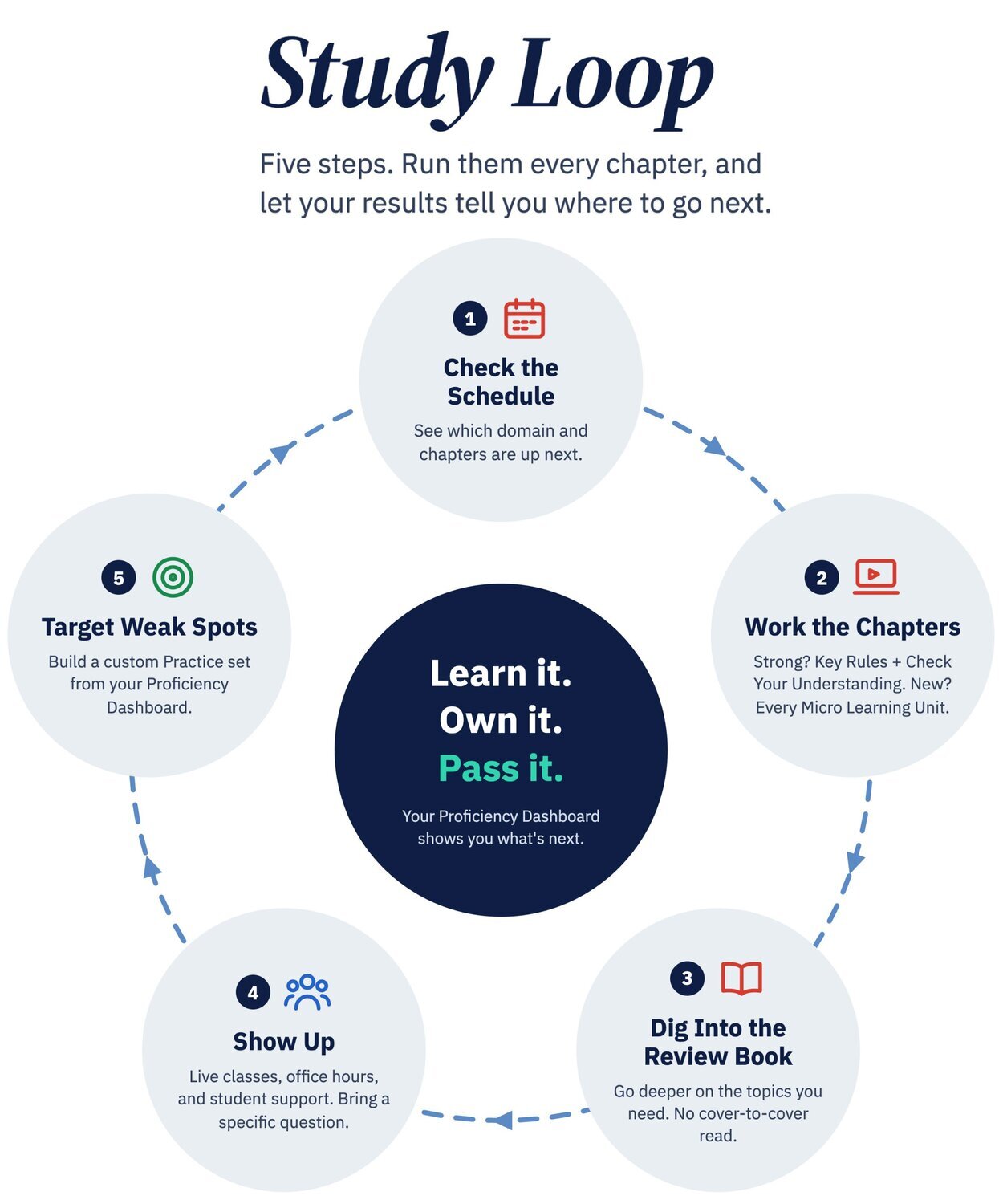
The Dalton Review® Study Loop: five steps you’ll repeat for every chapter, with your Proficiency Dashboard showing you where to focus next.
As you study, built-in AI tools are there when you get stuck. Ask the Q&A Assistant a question about the material, use Smart Search to find related content across the course, or highlight any term for an instant explanation with Smart Lookup. Split Screen lets you keep a reference document open beside your lesson, so you never lose your place.
Thirty-six hours of classes enhance your self-study, with class content mapped to the same material you study online. An expert instructor explains the “why” behind tough concepts, answers your questions in real time, and walks through the “what if” scenarios the exam loves to test.
You can choose live-online or in-person classes, on a weeknight, weekend, or 4-day schedule, depending on whether you want weekly classes throughout your study time or in a block near the end. You can also mix and match formats and attend as many review classes as you want during your review cycle, at no extra cost. For example, you could take an in-person class and still join live-online sessions on topics you want to hear again. And if you miss a session, class recordings and on-demand sessions are always available.
Between classes, you can drop into live office hours and student support sessions for extra help. And when a topic needs a deeper dive, turn to your Review Books.
Stage 3: Target your weak spots
As you work through each chapter, your Proficiency Report shows where you’re strong and where you need more work. Use it to build custom practice sets by chapter or topic, and take simulated exams that mirror the CFP® exam experience. That way, your study time goes where it counts.
Guarantee to Pass™ students also get flashcards and audio reviews to reinforce key concepts, whether you’re at your desk or on your commute, plus one-on-one coaching calls after your Review Readiness and Exam Readiness Quizzes to map out your next steps. Dalton Review® students can add on flashcards and the audio review.
Stage 4: Finish strong
In your final weeks, bring it all together with short scenario and case study question sets across domains. Then take the Exam Readiness Quiz on the preset date in your schedule. It tells you whether you’re ready before you sit for the exam, so there are no surprises on exam day.
Step-by-step guidance walks you through your final weeks and exam week. And after the exam, you’ll have next-step support, whatever your results.
Should you take The Dalton Review® twice?
For most candidates, one review cycle is all it takes. The Dalton Review® is built to get you exam-ready in a single cycle, from your first readiness assessment through your final live classes. But if you’re starting early, you have another option: take the full program twice, back-to-back, before you sit for the exam.
A review cycle is the complete program leading up to one exam window, including the online course, live review classes, and practice tools. Taking it twice means completing one full cycle as a first pass, without sitting for that exam, then going through the next cycle as your final prep.
Why do it? Some candidates want extra time and extra reps, especially if they’re new to financial planning, balancing a heavy workload, or coming back after a previous attempt. The second time through, you already know the material, so you can focus on the topics that need it most.
With The Dalton Review®, you can take the program a second time at no additional cost, something many other CFP® exam prep providers don’t offer. (This is different from mixing and matching live classes within one review cycle, which you can also do at no extra cost.)
Sample plans for taking the program twice
| Your examFirst cycleSecond cycle (final prep) | ||
| March | The review leading up to the November exam | The review leading up to the March exam |
| July | The review leading up to the March exam | The review leading up to the July exam |
| November | The review leading up to the July exam | The review leading up to the November exam |
Between reviews, keep working through the online course and practice questions so you build on what you learned the first time.
Frequently asked questions
Is three months enough time to study for the CFP® exam?
It can be, if you can commit 20 hours a week. If you can study about 10 hours a week, plan on closer to six months.
Can you study for the CFP® exam while working full time?
Yes, and most candidates do. The key is starting early enough that a steady number of hours a week gets you to about 225–250 hours by exam day. Pick a live class format and schedule that fits your life — online, in-person, or a mix of both — and build in a buffer for busy weeks.
How soon should you start if you’re retaking the exam?
Start soon after you get your results, while the exam is fresh in your mind. Your results show which areas held you back, so you can focus your first few weeks there. With The Dalton Review®, rolling over to a future review is always free. For more expert advice, read our 6-step plan for passing the CFP® exam on your next attempt.
Start training for exam day
The CFP® exam is a big step, and the right preparation makes all the difference. With a clear plan and an early start, you’ll walk in knowing the material, not hoping you remember it.
The Dalton Review® gives you a clear path from day one, practice that mimics the real exam, and a deep bench of expert instructors. And with The Dalton Review® Guarantee to Pass™, you’re backed by a 100 percent money-back guarantee.
Explore The Dalton Review® and find a schedule that fits your exam date.
Certified Financial Planner Board of Standards, Inc. (CFP Board) owns the CFP® certification mark, the CERTIFIED FINANCIAL PLANNER® certification mark, and the CFP® certification mark (with plaque design) logo in the United States, which it authorizes use of by individuals who successfully complete CFP Board’s initial and ongoing certification requirements.
Katie Morrison, PhD, CFP®, AFC® | Senior Content Lead, Dalton Education
Talk to an advisor today.
Our advisors are your go-to for everything CFP®. Need course recommendations? Extend a course? We’ve got you covered.
Office hours: M-F, 8am-5pm EST